The dining room, as a dedicated space, has quietly returned. After two decades of open-plan dominance, homeowners are again asking for an enclosed room with one table, one fixture, and a clear sense of occasion. Stone is doing much of the heavy lifting.
The argument for enclosure is partly acoustic — a room with four walls contains conversation — and partly ceremonial. When dinner happens in the corner of an open-plan kitchen, it reads as an extension of the cooking process. When it happens in a room designed for it, with a door that closes, the ritual of the meal is restored.
The Table
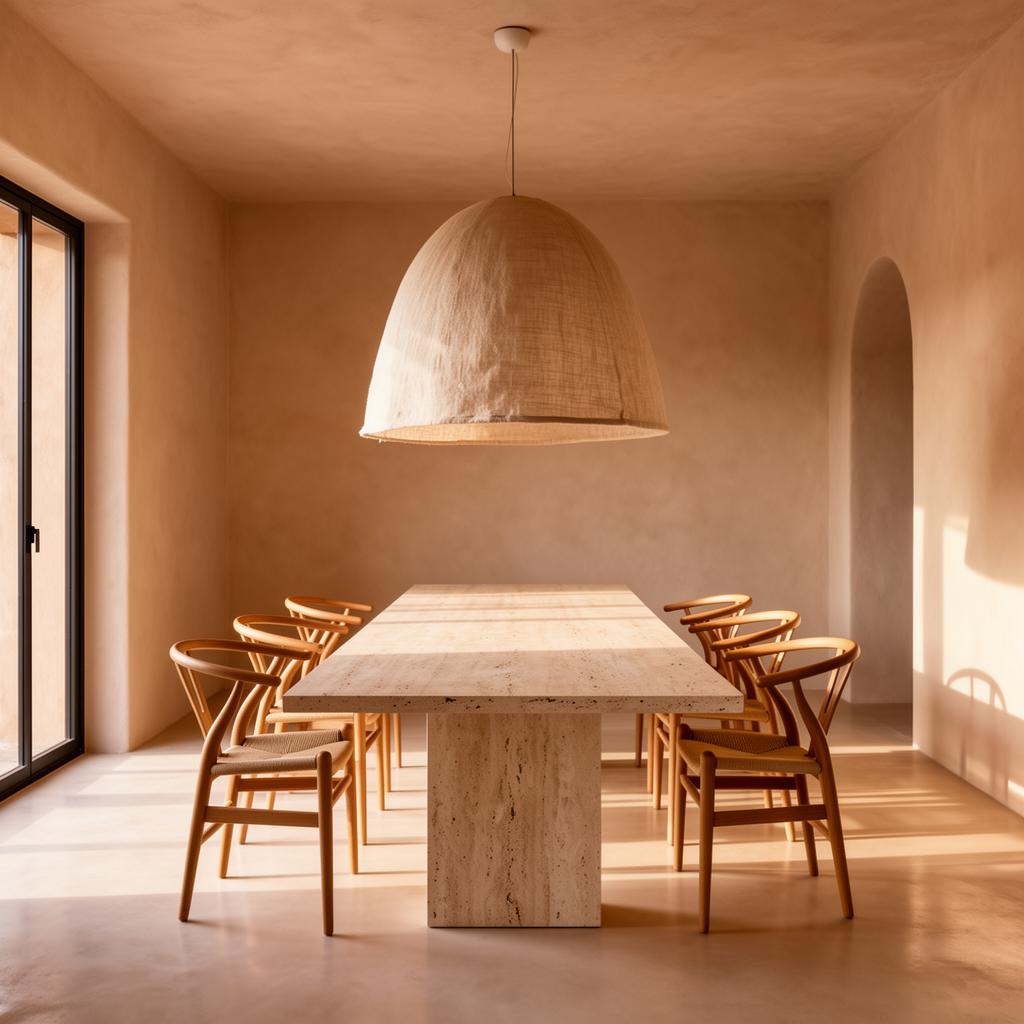
In a room designed around a single material, the table is the material’s primary expression. A travertine dining table — particularly one in honed Roman travertine, with its characteristic cross-cut fossil pattern — transforms the centre of the room into something between furniture and landscape. The surface, over years of use, develops a warmth that no new stone possesses.
The table should be sized for the room, not for a hypothetical maximum number of guests. A table that seats eight in a room that usually accommodates four creates a perpetual sense of emptiness. Better to have a table that seats six comfortably and occasionally feels full than one that always feels half-occupied.
The Walls
Limewashed plaster is the wall finish that works best in proximity to travertine. Both materials are calcium-based, and they share a quality of depth that paint cannot replicate — the sense that the surface has been built up over time, that it breathes. The colour should be drawn from the stone: a warm white, a pale ochre, a grey with yellow undertones.
A single architectural element — a recessed shelf, a frameless doorway, a plaster cornice — is enough. The dining room that tries to be interesting through accumulation of detail never arrives at the kind of quietness that makes long evenings possible.
Light
A pendant fixture positioned directly above the table is the only artificial light source the quiet dining room needs. The pendant should be warm — incandescent bulbs at low wattage, or the closest LED equivalent — and hung so that the light falls on the table surface and the faces of those seated around it, while the corners of the room recede into shadow.
Candles on the table complete the picture. Not as decoration but as function: they bring the source of light down to the level of the meal, and they change every fifteen minutes as they burn, in a way that no fixed artificial light can. The travertine surface, in candlelight, becomes something else entirely.