Bookmatching is one of the oldest and most demanding techniques in stone fabrication. Two consecutive slabs, cut from the same block, are opened like the pages of a book and installed side by side. The result is a perfectly mirrored composition — symmetrical, almost biological, often startling.
The process requires considerable extra material, exacting fabrication, and a designer’s willingness to commit to the pattern. Done well, it produces walls that function as paintings; done carelessly, it produces walls that look unresolved. There is no middle ground.
Selecting the Right Stone
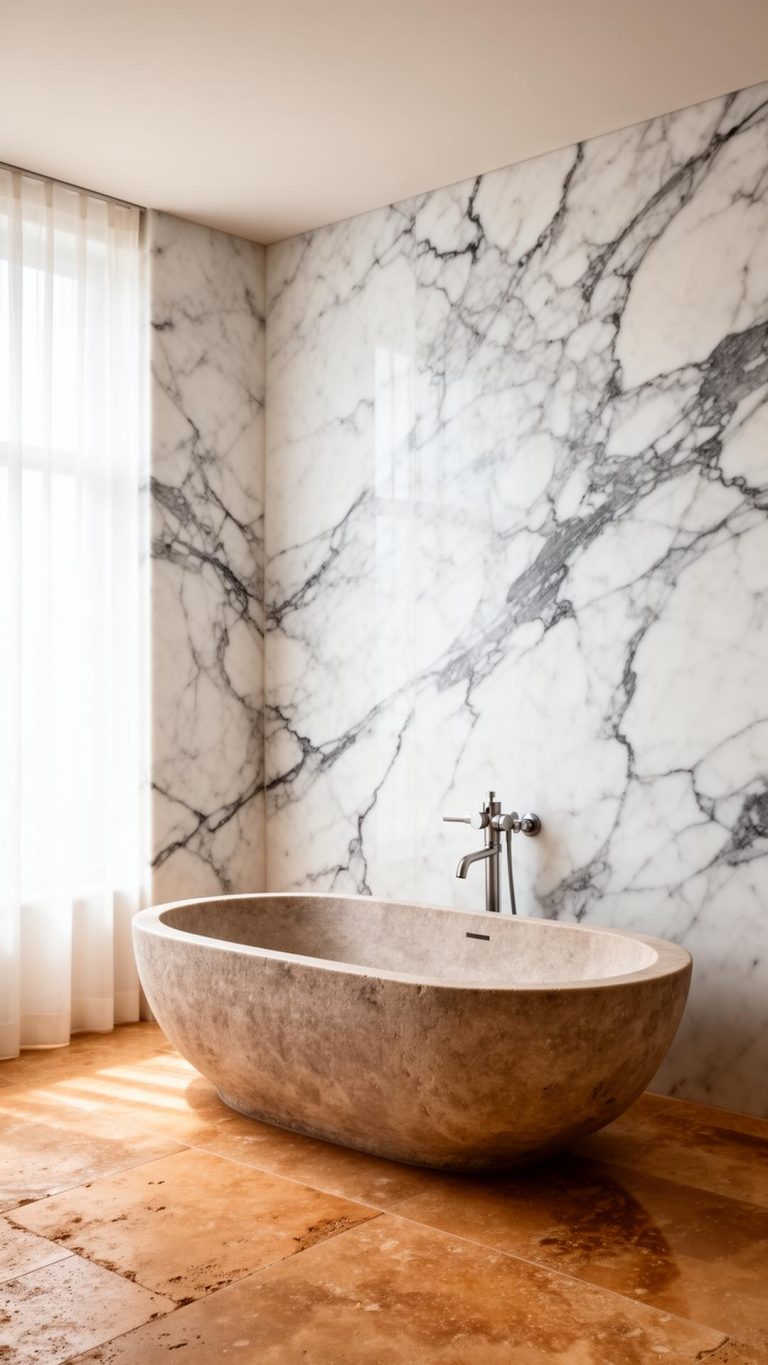
Not every stone bookmatches well. Stones with faint, atmospheric veining — grey Carrara, certain travertines — produce compositions that read as quietly symmetrical but rarely arrest attention. The stones that justify the technique are those with bold, directional movement: Calacatta Viola with its purple and gold veins, Patagonia quartzite with its storm-cloud patterning, Arabescato with its dark rivers cutting across a white ground.
The slab selection visit is especially important for bookmatched installations. The designer must evaluate not just the individual slab but what the mirror image will produce — the shapes formed in the negative space between the veins, the botanical or geological forms that emerge when two halves are reflected. Some slabs produce butterflies. Some produce landscapes. Some produce nothing coherent, and those should be left for other applications.
Where It Works
Bookmatched stone works best when it has space to be read as a whole. A bathroom where the bookmatched slabs run from floor to ceiling on a single wall — uninterrupted by towel rails, mirrors, or switches — gives the composition the presence it deserves. A kitchen where the bookmatched backsplash is interrupted every forty centimetres by a socket plate diminishes the effect to near nothing.
The best installations treat the bookmatched wall as the room’s primary artwork. Everything else — cabinetry, fittings, furniture — is arranged in relation to it, as one might arrange a sitting room around a painting. The composition is fixed; the rest of the room is framing.
Fabrication and Installation
The technical demands of bookmatching begin at the yard. The two adjacent slabs must be identified, labelled, and transported together without separation. At the fabrication shop, the cuts must be precisely planned so that the joint between the two slabs falls at the centreline of the composition — not to one side, where the symmetry would immediately read as wrong.
Installation requires a team that understands what they are handling. The slabs must be lifted, positioned, and adjusted in sequence, with the joint line checked continuously against a plumb line. Adhesive colour must be chosen to match the stone, and the joint must be finished to near invisibility. The difference between a bookmatched wall and a bookmatched wall done well is often only visible at close range — and it is everything.