Warm minimalism, as a phrase, has been so widely circulated that it risks losing its meaning. Properly understood, it describes a discipline rather than a style: the refusal to add a piece of furniture, a finish, or a colour that does not earn its place.
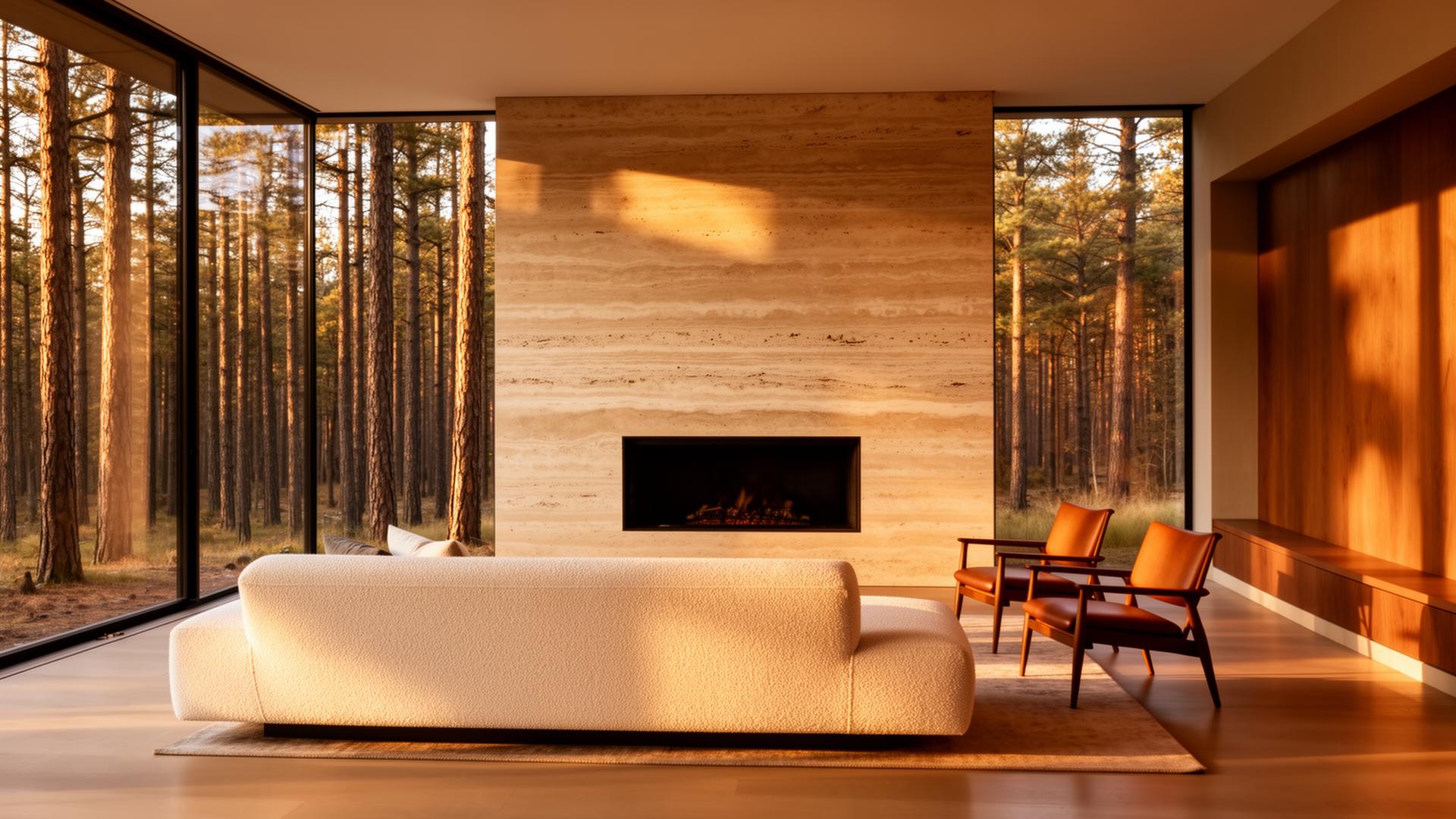
The living rooms we publish most frequently share a vocabulary. A travertine fireplace wall. A low boucle sofa. One or two wood pieces of integrity. Light, generously admitted. Nothing else, really.
The Fireplace as Anchor
In the living rooms that age best, the fireplace wall is the organisational centre of the room — the element around which everything else is arranged and to which everything else defers. Stone is the natural material for this role. It brings mass, warmth when lit, and a coolness when unlit that reads as composure rather than emptiness.
Honed travertine is the current favourite for fireplace surrounds. Its warm beige tones read well against both light linen and dark joinery, and its unfilled surface — with its characteristic voids and fossils — gives it a geological honesty that polished marble lacks. A travertine fireplace does not announce itself. It simply belongs.
On Furniture Selection
The furniture decisions in a warm minimalist living room are harder than they appear. Every piece must be chosen for its silhouette as much as its comfort — for the space it occupies when unoccupied, for the shadow it casts at four in the afternoon. Low furniture creates a sense of horizontal calm; tall furniture breaks it.
The boucle sofa has become so ubiquitous that it risks cliché, but the underlying logic is sound. The textured, loop-pile fabric reads as warm from a distance and holds up to domestic use. In a room with a strong stone element, the softness of boucle provides necessary contrast without introducing colour. Natural linen, aged leather, and heavy cotton are the other fabrics that earn their place in these rooms.
Light and the Time of Day
A well-designed living room changes character across the day. In the morning, natural light from east-facing windows picks up the warmth in travertine. At midday, the room settles into its own presence. In the evening, the balance shifts to artificial light — and here, the quality of the lighting matters enormously.
The living rooms that work at night are those where the artificial light is warm, low, and layered. Wall sconces at seated eye height, table lamps with paper or linen shades, a single floor lamp positioned to create a pool of reading light. Recessed ceiling lights, used exclusively, produce a flatness that flattens stone and fabric alike. They should be used sparingly, if at all.